
Diocese of Sts. Joseph & George
Rev. Mark Schmidt, Th.D.
A priest, theologian, and Army veteran whose careful, candid faith makes room for doubt, questions, and people.

Priest · Theologian · Retired U.S. Army veteran
Mark answered these questions with unusual care. Instead of smoothing his life into a simple vocational story, he stopped to examine the assumptions behind each question, named what he could honestly say, and followed each answer back to the people at its center.
“The people are the heart and soul of the Church.”
An unhurried, honest conversation
Mark’s answers are candid, funny, searching, and deeply attentive. He does not reach for a polished origin story or pretend that every question has a tidy answer. He pauses when a question is large, corrects a premise when it asks him to claim more than he has said, and leaves room for what is still unfolding.
What emerges is a life shaped by twenty years in the U.S. Army, a forced medical retirement, family responsibilities, years away from organized religion, a gradual return to Christian faith, doctoral study, and an unconventional call to priesthood. Mark never treats those chapters as résumé lines. He treats them as experiences that taught him how to listen.
More than a title
Asked how he would introduce himself outside church, Mark answers, “Usually just Mark.” At a motorcycle gathering he might be “Chappy,” “Chaplain,” or even “Hey Priest.” At a book club or coffeehouse, he is simply Mark. Titles are situational to him; what matters more is whether people know who he is and what he does.
That groundedness runs through the details he offers about ordinary joy: family, his motorcycle, books, a good cup of coffee, friends, and humor. He values knowledge, friends, and family, and believes that if we cannot laugh as we go through life, we are missing the point. He also resists being placed at either extreme—neither hard and unforgiving nor soft and a pushover, but somewhere in between.
Twenty years of attention and listening
When asked how the Army shaped him, Mark begins by acknowledging the size of the question: “Wow, that is a big question filled with answers.” He names two lessons plainly—attention to detail and listening. He also remembers a year serving as a chaplain’s assistant, learning the small things and allowing that experience to stimulate his curiosity.
At first, Mark says, he had lumped believers together without distinguishing among their traditions. But the practical truth remained: Jews, Muslims, Protestants, Catholics, pagans—people of every belief pattern had needs, and the work was to help guide them if possible. His departure from the Army was a forced medical retirement. The next chapter was not an abstract search for purpose; it was feeding his family and paying the bills. That answer refuses to retrofit a calling onto a life that, at the time, demanded practical care.
Faith remained when institutions did not
Mark’s account of leaving church begins in childhood. He describes growing up in the 1950s and 1960s, when children whose parents attended church were expected to attend too. He walked away in high school after church no longer seemed to offer value to his life and began to feel controlling and condemning.
But he is careful about the distinction: he did not stop believing. He kept faith private while losing confidence in organized religious institutions that seemed more concerned with the house of God than with the person. “Finally, a real question that matters,” he writes when asked whether he had lost faith itself. For Mark, the question matters because people—not clergy, buildings, dogma, or ritual—are the heart and soul of the Church.
That conviction gives his theology a practical center. Faith is not a way to avoid hard questions or reduce people to categories; it is a way of remaining present to one another when easy answers do not hold.
A return that happened gradually
Mark’s willingness to reconsider Christianity came through his mother on her deathbed and through a young friend. He does not describe a single dramatic conversion. Faith gradually “creeped up” on him, becoming fully apparent when he enrolled in a doctoral program in theology.
He believes his years of doubt made him a better priest. When someone thinks walking away from church means they have failed spiritually, Mark does not offer a slogan. He offers a conversation, a coffee or tea, and a willingness to stay with that person on their journey. For him, the person did not fail simply because an institution failed to meet them.
Theology as a tool, not a substitute
Serious study gave Mark clarity and more questions at the same time. He describes gaining a deeper understanding of how biblical writings can be altered to serve agendas rather than faith. He also names a distinction he wishes more ordinary churchgoers had the opportunity to explore: theology is not faith or belief. It is a tool that can guide the journey, not a replacement for the journey itself.
Mark says he recognized the call to ordained ministry before he began studying. Study was a tool for understanding, not a way to manufacture a calling. Ordination did not change who he was; it changed how he felt about who he was. Even being called “Father” is a label he holds lightly. What matters more is whether people know him and what he does.
A welcome shaped by listening
Mark came to the Reformed Catholic community because Bishop Shane took the time to talk with him about him—why he had come and what he wanted to do. That experience of being met as a person helps explain what he now offers others.
Asked how he welcomes people who arrive with doubt, anger, wounds, or skepticism, his answer is direct: he listens to understand, not to respond. To someone who still loves Catholic spirituality and sacramental life but feels there is no place for them in an institution, he would say, “Let’s get a coffee and have a conversation.” For Mark, that is not a detour from ministry. It is ministry.
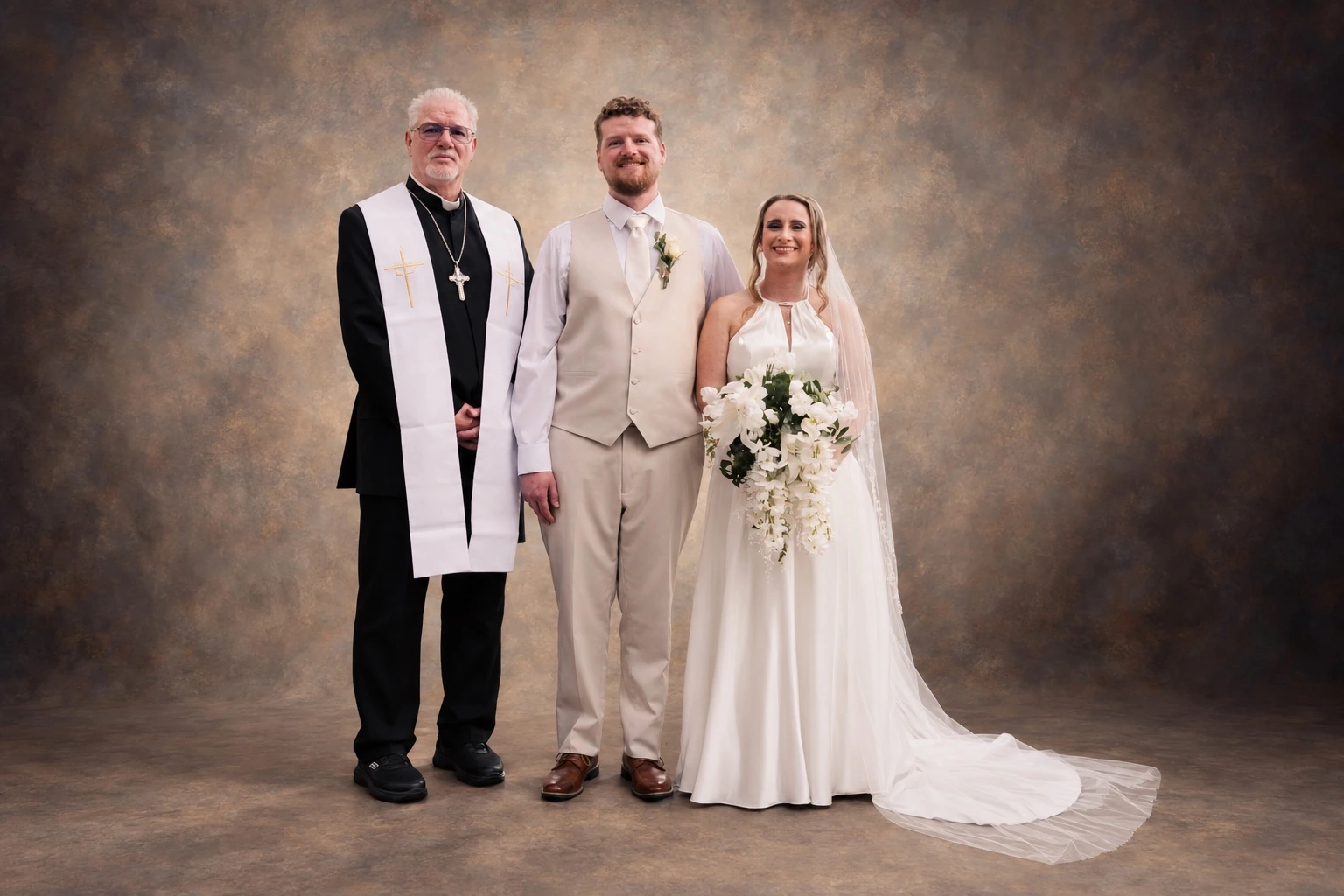
A first wedding as a priest
A path still full of promise
Mark does not end with a tidy conclusion. He sees the road ahead as a path not yet revealed, still full of promise and adventures. The care in his answers is part of the invitation: slow down, ask the real question, listen carefully, and allow faith to remain a living journey.
Continue the conversation
Send Mark a message
Ask Mark a question or start a conversation. He can reply to the email address you provide.